Over the next several weeks, we are publishing a series of blog posts that dive into each chapter of our 11 Things You Should Know About Infrared Windows guide. This series unpacks the technical details, practical tips, and real-world considerations that every maintenance professional needs to know when specifying, installing, and using IR windows. If you want the full picture right away, you can download the complete eBook here.
Electrical maintenance today demands both accuracy and safety. Infrared (IR) inspection windows are an intelligent solution that meets both requirements. These specialized access points allow thermal inspections to be performed while equipment remains energized, yet safely enclosed. By creating a safe, permanent inspection point, IR windows make inspections faster, more reliable, and far less hazardous than opening panels manually.
IR windows have been adopted across a broad range of industries. Instead of interrupting operations or exposing inspection teams to unnecessary risk, IR windows provide a simple way to keep maintenance programs efficient and compliant.
How Does an Infrared Inspection Window Work?
An infrared inspection window provides an optical path through an equipment enclosure, allowing a compatible thermal camera to detect infrared radiation from components inside. The main enclosure doors and covers remain in place during the inspection.
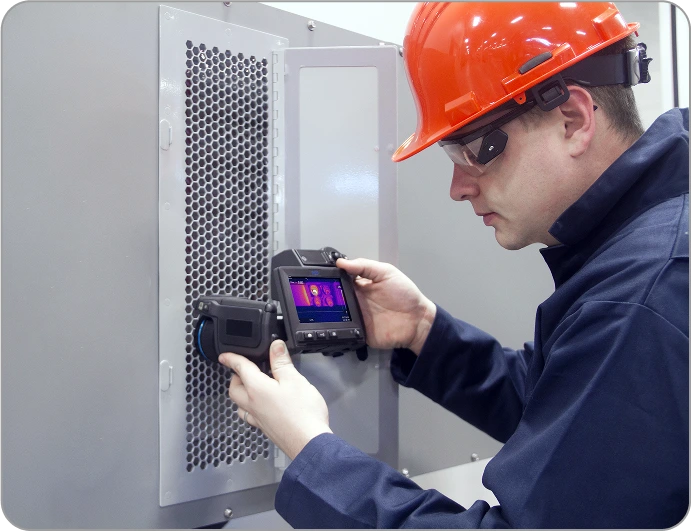
The window contains a specially selected infrared-transmitting material mounted within a frame. During an inspection, the technician opens the window’s protective cover, where fitted, and positions the camera outside the optic. The camera produces a thermal image that can reveal abnormal temperature patterns.
The window itself does not measure temperature or diagnose faults. It provides access for the camera, while the thermographer interprets the results using equipment condition, operating load, and other relevant information.
Because the optic transmits only a portion of the incoming infrared radiation, temperature measurements require appropriate transmission compensation. Focus, target emissivity, reflected temperature, and target size also affect measurement quality.
Types of Infrared Windows
IR windows are available in several forms, each designed for different conditions and safety requirements.
Viewing Panes
Solid optics that maintain an enclosed and guarded condition. They allow inspections without elevated PPE requirements, reducing time and cost.
Inspection Grills
Grills use a mesh design that supports both infrared and ultrasound inspections. However, they do not fully enclose equipment, which means higher PPE levels may still be required.
Inspection Ports
Small openings, usually under 15mm, that may include a specialty lens or remain open. Whether sealed or unsealed, ports directly affect compliance with safety standards.
Custom Solutions
When standard options don’t fit, custom-designed windows can enable inspections in difficult or high-risk areas. These should always be reviewed and approved by corporate safety officers.
Benefits of Infrared Inspection Windows
Infrared inspection windows make recurring inspections easier to perform while reducing the need to interact with energized equipment.
- Reduced exposure: Technicians can inspect accessible targets without removing the main enclosure covers.
- Faster access: Less time is spent opening, dismantling, and restoring equipment.
- Inspections under load: Teams can observe thermal conditions while equipment operates.
- Repeatable inspection points: Permanent access locations help technicians return to the same components.
- More practical inspection schedules: Easier access can help teams complete routes consistently.
- Better maintenance information: Repeated inspections provide evidence for investigating changes and prioritizing work.
These benefits depend on appropriate window placement, competent inspection, and follow-up action. Installing a window creates access; the inspection and maintenance process turn that access into operational value. IRISS inspection window benefits
Enclosure Integrity: A Key Factor
The most critical factor in choosing an IR window is whether it maintains an enclosed and guarded condition. If this is preserved, inspections can be performed safely with reduced PPE. If it’s not, technicians face higher risks and compliance becomes more complex.
Enclosure integrity impacts not only worker safety but also costs associated with PPE, inspection time, and regulatory requirements. For all electrical operations, choosing an IR window with the highest level of enclosure integrity should be a top priority.
Environmental Ratings and Compliance
IR windows must withstand the same conditions as the equipment they are built into. That’s why their environmental ratings must meet, or ideally exceed, the original enclosure standards. Factors to consider include:
- Ingress Protection (IP) ratings. These confirm a window’s resistance to dust and moisture.
- NEMA Ratings, which validate durability against environmental challenges such as rain, snow, or corrosion.
- If a window’s rating falls short of the equipment’s rating, its ability to protect could be compromised.
Where Are Infrared Inspection Windows Used?
Infrared inspection windows are used where an enclosure prevents direct thermal observation of important components.
Common electrical applications include:
- Switchgear and switchboards: Connections, bus joints, and accessible switching components.
- Motor control centers: Starter connections, contactors, and power terminations.
- Distribution panels: Accessible circuit connections and distribution components.
- Transformer enclosures: Visible terminations and other suitable inspection targets.
- UPS and power distribution equipment: Accessible electrical connections within critical power systems.
- Busway systems: Joints and connection points where the design permits inspection access.
These applications occur across manufacturing, data centers, healthcare, utilities, commercial buildings, and other facilities that depend on reliable electrical equipment.
Specialized inspection windows are also used in furnaces and industrial ovens. These require materials and assemblies designed for the process conditions. For example, the IRISS HT Series uses sapphire optics and stainless steel construction for high-temperature applications. IRISS HT Series
A window only provides access to targets within its usable view. Internal barriers, cables, and infrared-opaque guards can still obstruct inspection.
How to Choose the Right Infrared Inspection Window
- Identify the inspection targets
List the components that need examination before choosing a window size or location. Record their dimensions, depth, and position within the enclosure.
- Confirm camera compatibility
Match the window’s spectral transmission to the camera’s operating wavelength band. Check the actual camera and lens combination, including focusing distance and measurement resolution.
- Verify inspection coverage
Assess the clear opening, camera positions, and internal obstructions. A component must be both visible and sufficiently large in the thermal image for the intended measurement. Window coverage and camera measurement capability are separate considerations. IRISS field-of-view guide
- Evaluate the environment
Consider temperature, moisture, dust, chemicals, corrosion, vibration, and cleaning practices. Check the complete assembly, including its optic, frame, seals, and protective cover.
- Review equipment compatibility and approvals
Confirm that the proposed modification is acceptable for the enclosure. Review installation requirements, electrical clearances, applicable ratings, and any manufacturer or engineering approvals.
- Consider additional inspection methods
Some assemblies support visual or ultraviolet inspection, while others incorporate ultrasound access or partial discharge sensing. Select these capabilities according to the inspection program. Specific CAP Series configurations combine several inspection methods. IRISS CAP Series
- Compare total installed value
Include installation, coverage, inspection time, upkeep, and expected service conditions. A lower purchase price offers little value if important targets remain inaccessible.
Value for all Stakeholders
For leadership teams, IR windows represent a cost-effective safety investment. For engineers and site managers, they simplify inspections, improve accuracy, and minimize downtime. Across all levels, they support condition-based maintenance strategies by making thermal data easier to collect and analyze.
Best Practices for Maximizing Infrared Window Field of View
- Begin with a target schedule
List each connection or component that must be inspected. Record its location, approximate dimensions, depth, and any obstruction affecting access.
- Evaluate the actual camera and lens
Use the equipment intended for routine inspections. Confirm angular FOV, minimum focus distance, measurement spot requirements, and physical clearance around the lens.
- Match the window arrangement to the equipment
Compare different opening sizes, shapes, and positions. Multiple appropriately located windows may provide better coverage than one large window where internal compartments restrict sightlines.
- Test the proposed arrangement
Use a representative mockup or an approved assessment during a planned outage. Reproduce the window opening, frame depth, target locations, and practical camera positions. Check both visibility and measurement capability.
- Establish repeatable viewing positions
Document where the camera should be positioned for each target. Repeatable positioning helps inspectors compare images and identify the correct component during subsequent surveys.
- Verify measurement settings separately
Adequate coverage does not compensate for incorrect emissivity, reflected temperature, or window transmission settings. Confirm the applicable settings and maintain the window’s optical condition.
- Record limitations explicitly
Identify targets that cannot be inspected through the proposed arrangement. Assign an appropriate alternative inspection method rather than marking the entire enclosure as covered.
The Takeaway
Infrared inspection windows are critical safety and efficiency tools. Choosing the right type, ensuring they maintain enclosure integrity, and confirming environmental compliance ensures safer and more productive inspections.
By doing so, organizations gain a clear path to safer operations, reliable data collection, and reduced maintenance risks.
Dive Deeper Into IR Windows
There’s more to know, plus all the technical info you need to make informed decisions about safer inspections. View our free eBook: 11 Things You Should Know About Infrared Windows
Frequently Asked Questions
The following questions explain how window geometry and camera performance affect inspection coverage and temperature measurement.
What is an infrared window field of view (FOV)?
It is the area inside an enclosure that a thermal camera can observe through an infrared window. Coverage depends on the opening, camera lens, viewing position, target distance, and obstructions. The total area accessible by repositioning the camera may be larger than the area captured in one image.
How do you calculate the field of view through an infrared window?
Start by calculating the camera’s unobstructed coverage at the target plane:
Coverage = 2 × distance × tan(viewing angle ÷ 2)
Calculate horizontal and vertical coverage separately using the corresponding lens angles. For example, a 24° horizontal lens angle at a lens-to-target distance of 0.5 meters gives approximately 0.213 meters, or 213 millimeters, of horizontal coverage. The target plane is assumed to be perpendicular to the viewing direction. IRISS infrared window guide, Chapter 5
Then evaluate the window’s clear opening, frame restrictions, camera standoff, and obstructions. Assess additional camera positions separately to establish total accessible coverage.
Simply adding the window width to a single-image calculation is not a universal method for determining installed WFOV. Verify the proposed geometry with a representative test.
What is the difference between MFOV and WFOV?
MFOV concerns the minimum target size needed for reliable temperature measurement at a given distance. WFOV concerns the area accessible through the inspection window.
A successful arrangement must provide both access to the required components and sufficient measurement resolution. Seeing a connection through the window does not automatically mean its temperature can be measured accurately.
Why is field of view important for infrared inspections?
Field of view determines whether the inspection includes the required components. Poor coverage can leave connections unexamined or force inspectors to rely on incomplete views.
Planning coverage also supports consistent inspection routes, clearer component identification, and more useful comparisons between surveys. Any inaccessible targets should be recorded as inspection limitations.
How does a thermal camera’s field of view affect infrared inspections?
A wider angular FOV captures more equipment in one image, which can help in confined spaces. A narrower FOV can place more pixels across a small target at the same distance, improving the available detail.
The appropriate lens depends on target size, working distance, access, and the required measurement performance. Wider coverage is useful only when the inspection still provides sufficient detail.
How far can a thermal camera see during an infrared inspection?
There is no single inspection distance that applies to every camera or target. The useful measurement distance depends on target dimensions, lens selection, detector resolution, focus, and the camera’s specified measurement performance.
Detecting a thermal feature and measuring its temperature reliably are different capabilities. For inspections through windows, the opening and internal sightlines impose additional limits.
Use the manufacturer’s measurement spot specification for the actual camera and lens. Do not infer maximum measurement distance from detector resolution alone.
How do you choose the correct infrared window for maximum inspection coverage?
Identify the required targets first, then evaluate their positions against the available camera locations. Select a clear opening and window arrangement that provide suitable sightlines and room to position the camera.
Confirm wavelength compatibility, enclosure suitability, installation requirements, and measurement resolution. The best choice provides verified coverage of the required targets within the equipment’s design constraints.
Can the wrong infrared window size affect inspection accuracy?
Yes, an unsuitable opening can obstruct the optical path, hide part of a target, or restrict the camera to an unfavorable position. These conditions can compromise inspection completeness and temperature measurement.
However, a larger window does not automatically improve accuracy. Focus, target size in the image, emissivity, reflections, and transmission compensation still require attention.
What are the best practices for maximizing infrared window field of view?
Map the inspection targets, use the actual camera and lens specifications, and select window positions around verified sightlines. Test the arrangement before installation, including access to targets near the edges of the proposed coverage.
Document repeatable camera positions, confirm that each target meets measurement requirements, and record any inaccessible components. Review coverage again when equipment layouts or inspection cameras change.